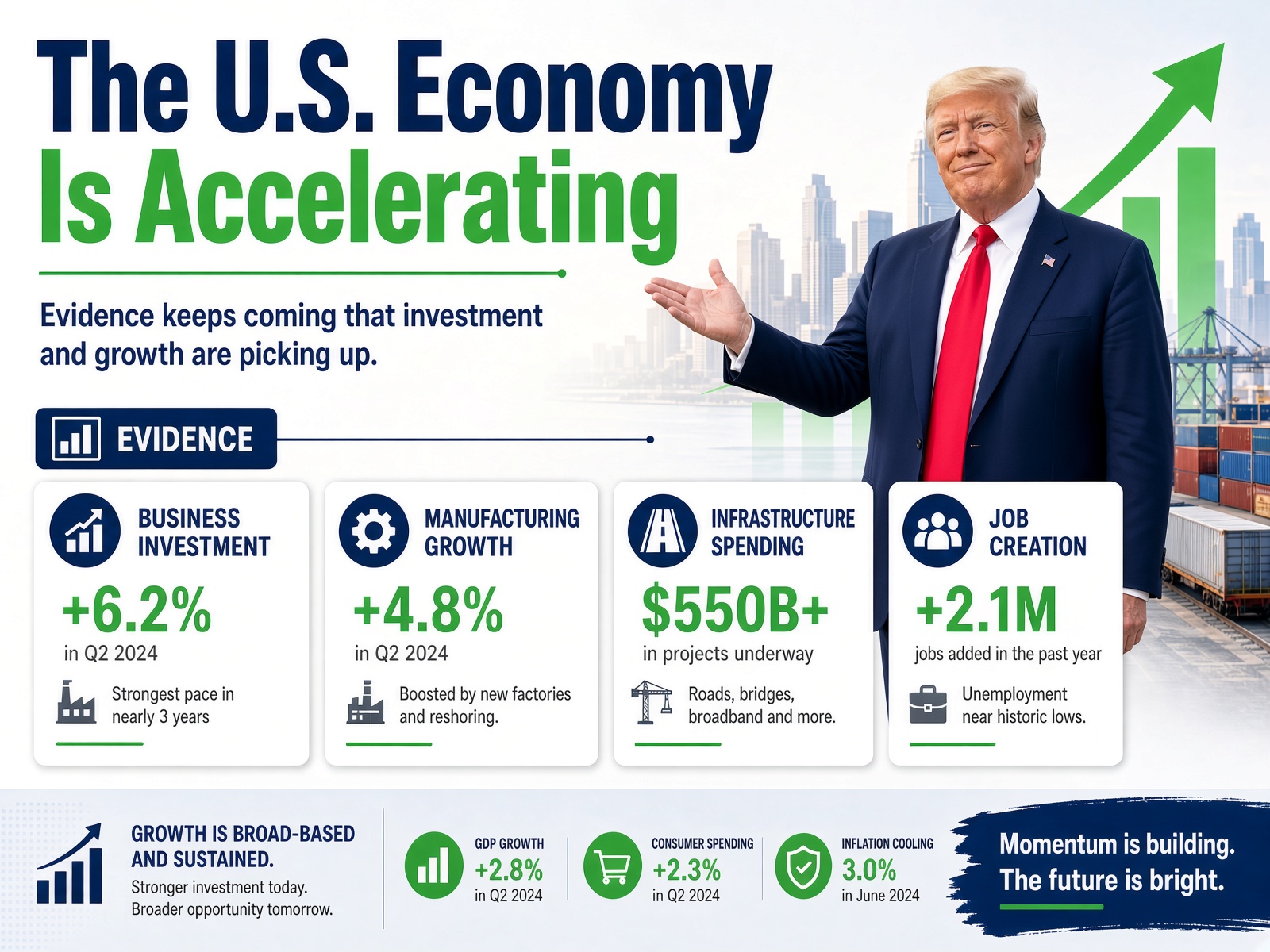
U.S. Economy Shows Broadening Signs of Acceleration
A growing body of economic data is pointing in the same direction: the United States economy appears to be picking up speed. From rising business investment to a resilient labor market, recent indicators have been consistent enough to shift the conversation among economists from whether a recession is coming to how durable the current expansion might be.
The shift in tone reflects a broader reassessment. For much of the past two years, the dominant concern was that the Federal Reserve’s aggressive campaign to bring down inflation — which drove benchmark interest rates to their highest levels in decades — would tip the economy into a downturn. That downturn has not arrived. Instead, growth has continued, and in some areas has begun to accelerate.
Investment Leading the Way
One of the clearest signals has come from the business investment side of the economy. Capital spending on manufacturing facilities, technology infrastructure, and industrial equipment has risen notably, partly driven by federal legislation aimed at reshoring semiconductor production and expanding domestic clean energy capacity. Projects funded under those initiatives are still in early or mid-construction phases, meaning investment spending in those categories is likely to remain elevated for some time.
Beyond the policy-driven surge, broader corporate capital expenditure has also held up, suggesting that businesses — despite higher borrowing costs — retain enough confidence in future demand to commit to long-term investments.
Labor Market Remains a Foundation
The labor market has continued to provide a stable base for the expansion. Job creation has stayed positive across a range of sectors, keeping unemployment low by historical standards and supporting household income. That income, in turn, has helped sustain consumer spending, which accounts for the largest share of overall economic output.
Consumer activity has defied repeated predictions of an imminent pullback. While spending patterns have shifted — with households becoming more selective about discretionary purchases — overall demand has not collapsed in the way some models projected given current interest rate levels.
GDP and the Wider Picture
Gross domestic product figures have broadly reinforced the investment and labor market data. Output has grown at a pace that, while not dramatic, has consistently surprised on the upside relative to more pessimistic forecasts. Revisions to earlier estimates have, in several instances, painted a stronger picture than initially reported.
Caveats Remain
Economists caution that acceleration is not the same as a smooth or evenly distributed expansion. Some sectors continue to struggle under the weight of high borrowing costs, particularly commercial real estate and rate-sensitive corners of manufacturing. Global uncertainties — including trade policy shifts and slower growth among major trading partners — could yet temper domestic momentum.
The Federal Reserve, meanwhile, faces the challenge of calibrating its next policy moves against a backdrop that is more dynamic than expected. Strong growth data complicates the case for rapid interest rate cuts, even as some corners of the economy would benefit from lower borrowing costs.
For now, the accumulation of positive data points has given forecasters reason to revise their outlooks upward — and businesses and consumers reason to approach the months ahead with somewhat greater confidence.