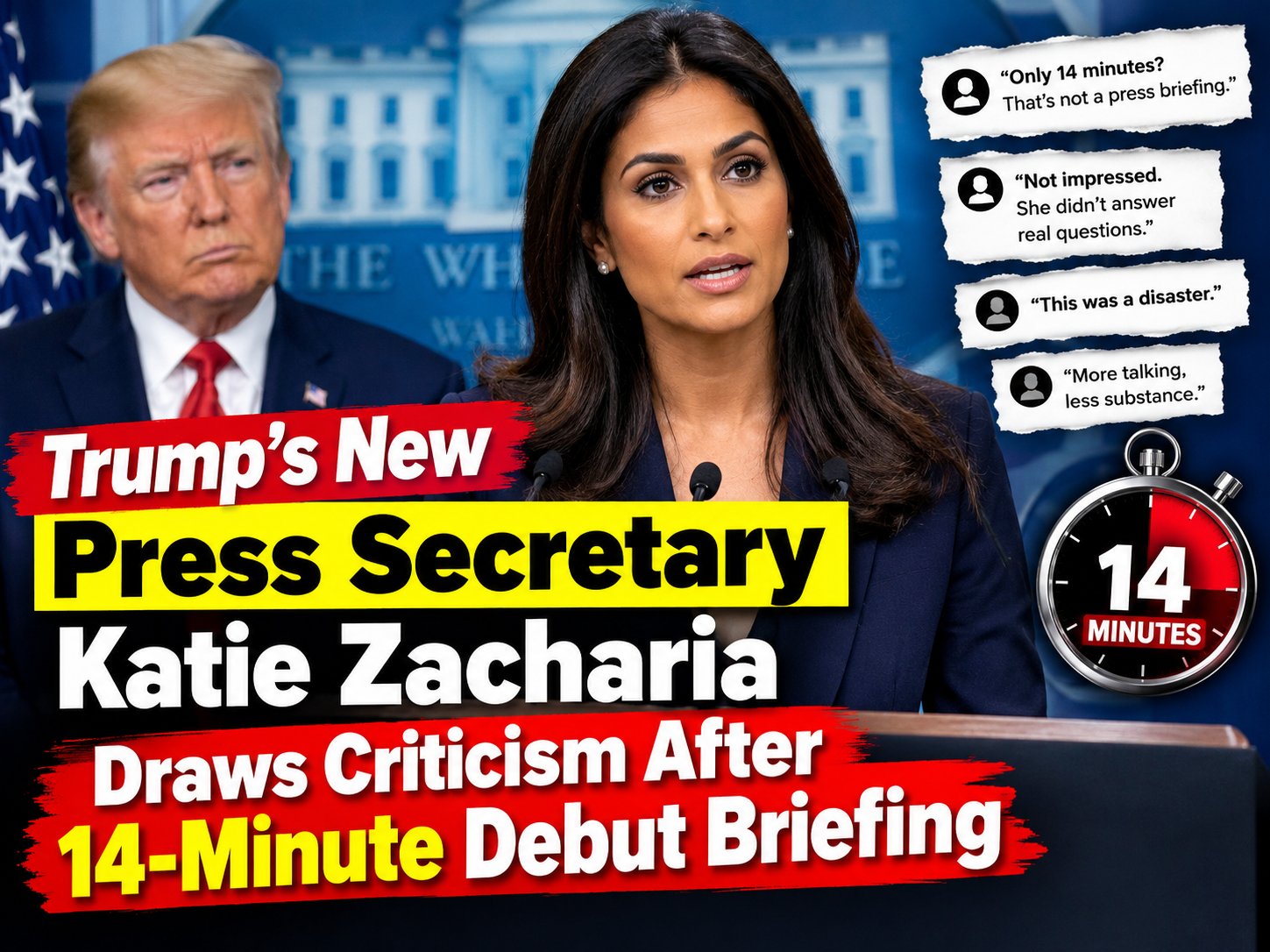
Trump’s New Press Secretary Draws Fire After Brief, Scripted Debut
Katie Zacharia, the newly appointed White House press secretary under President Donald Trump, faced an immediate wave of criticism following her first official briefing, which lasted approximately 14 minutes and included questions from just three reporters.
The session, closely watched by journalists and media analysts as a signal of how the administration intends to handle press relations, drew pointed commentary for both its brevity and its selectivity. Observers noted that Zacharia, a former commentator for the conservative cable channel Newsmax, appeared to rely heavily on prepared notes throughout the briefing rather than fielding questions extemporaneously — a departure from the more free-form exchanges that veteran press secretaries are expected to manage.
For members of the White House press corps, the short duration and narrow field of questions raised immediate concerns about transparency and access. Reporters who were not called upon left the briefing room without having had the opportunity to ask questions on subjects ranging from domestic policy to ongoing international developments.
Critics of the administration were quick to highlight the contrast with the expectations of the role. The press secretary serves as the primary public-facing liaison between the executive branch and the journalism community, and the position carries with it an implicit obligation to engage broadly and substantively with the press on behalf of the public.
Zacharia’s background at Newsmax — an outlet with a well-established ideological alignment with the Trump political movement — has added another layer of scrutiny to her appointment. Some media observers have questioned whether her prior role as a commentator, rather than as a working journalist or communications professional with government experience, adequately prepared her for the demands of the position.
Defenders of Zacharia have noted that first briefings are often shorter than subsequent ones, and that any press secretary requires time to settle into the rhythms of the job. The Trump administration has historically argued that it communicates directly with the American public through alternative channels, reducing its reliance on traditional press briefings.
Nonetheless, the debut has energized critics who have long argued that the administration treats the press corps as an obstacle rather than an accountability mechanism. Press freedom advocates have pointed to limiting briefing access as part of a broader pattern of restricting information flow from the executive branch.
How Zacharia’s performance evolves in the coming weeks is likely to determine whether her debut is remembered as an understandable rough start or as a preview of a more restrictive approach to White House press relations.