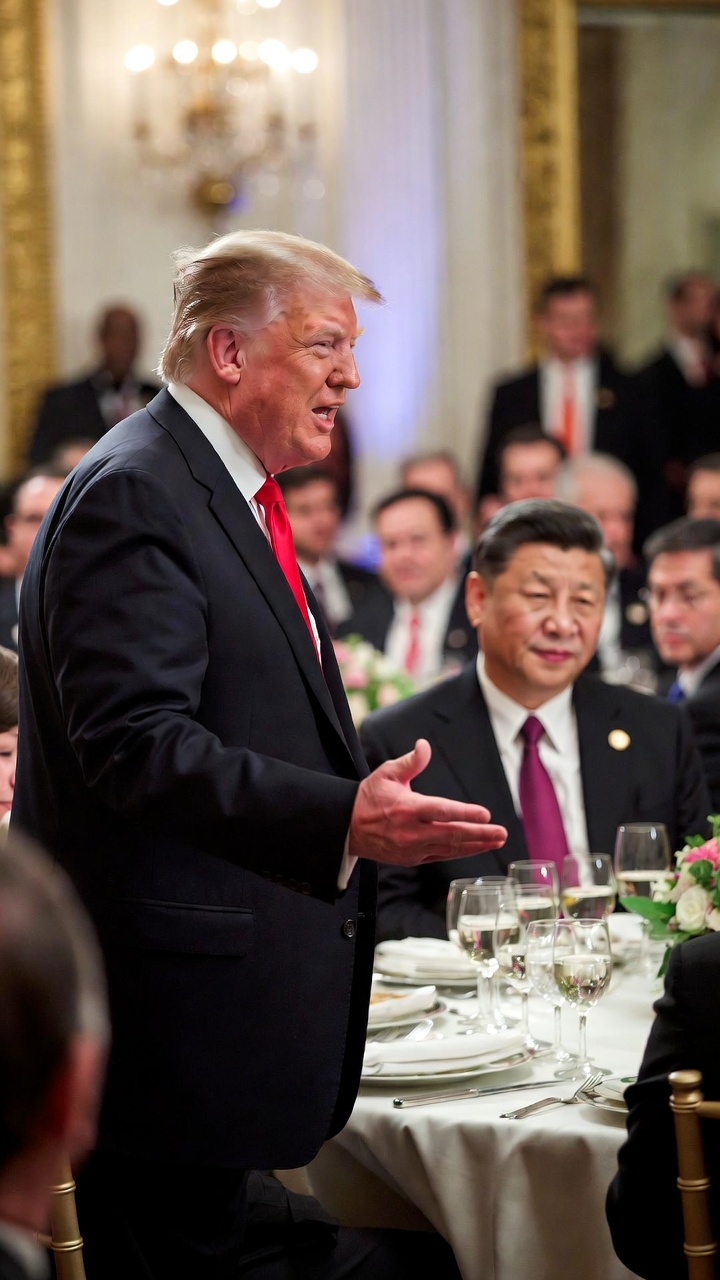
President Trump departed from his prepared remarks during a state dinner with Chinese President Xi Jinping, directing attention toward plans for a new ballroom at the White House.
The informal comments came during an event designed to showcase bilateral relations between the United States and China. State dinners typically feature closely coordinated speeches and formal protocols, making spontaneous asides unusual in such settings.
Trump’s tendency to veer from scripted remarks during official occasions has been a consistent feature of his public appearances. At diplomatic functions, ceremonial events, and formal gatherings, he frequently interjects personal observations, commentary on unrelated topics, or spur-of-the-moment remarks that diverge from advance materials.
Details about the proposed ballroom project remain limited. The White House has undertaken various renovation and maintenance initiatives over the years, though significant expansions or additions to the residence require extensive planning and coordination with preservation specialists, given the historic nature of the building.
The specific remarks Trump made about the ballroom—including its timeline, estimated cost, or architectural specifications—were noted by attendees and observers present at the dinner. The comments occurred in a setting where diplomatic messaging is typically controlled closely, leading observers to view the detour as characteristic of Trump’s unfiltered communication style.
State visits between the United States and China carry substantial geopolitical significance. The formal dinner portion of such visits is generally structured to reinforce bilateral cooperation and set a diplomatic tone for substantive discussions. Trump’s introduction of domestic facility planning into that context reflected his preference for combining social settings with personal interests.
The incident underscores the challenge of managing formal presidential rhetoric when the chief executive favors spontaneity over strict adherence to prepared text. Communications staff at major state events face the reality that prepared remarks may be modified, expanded, or supplemented with unscripted commentary depending on the moment and the president’s inclinations.