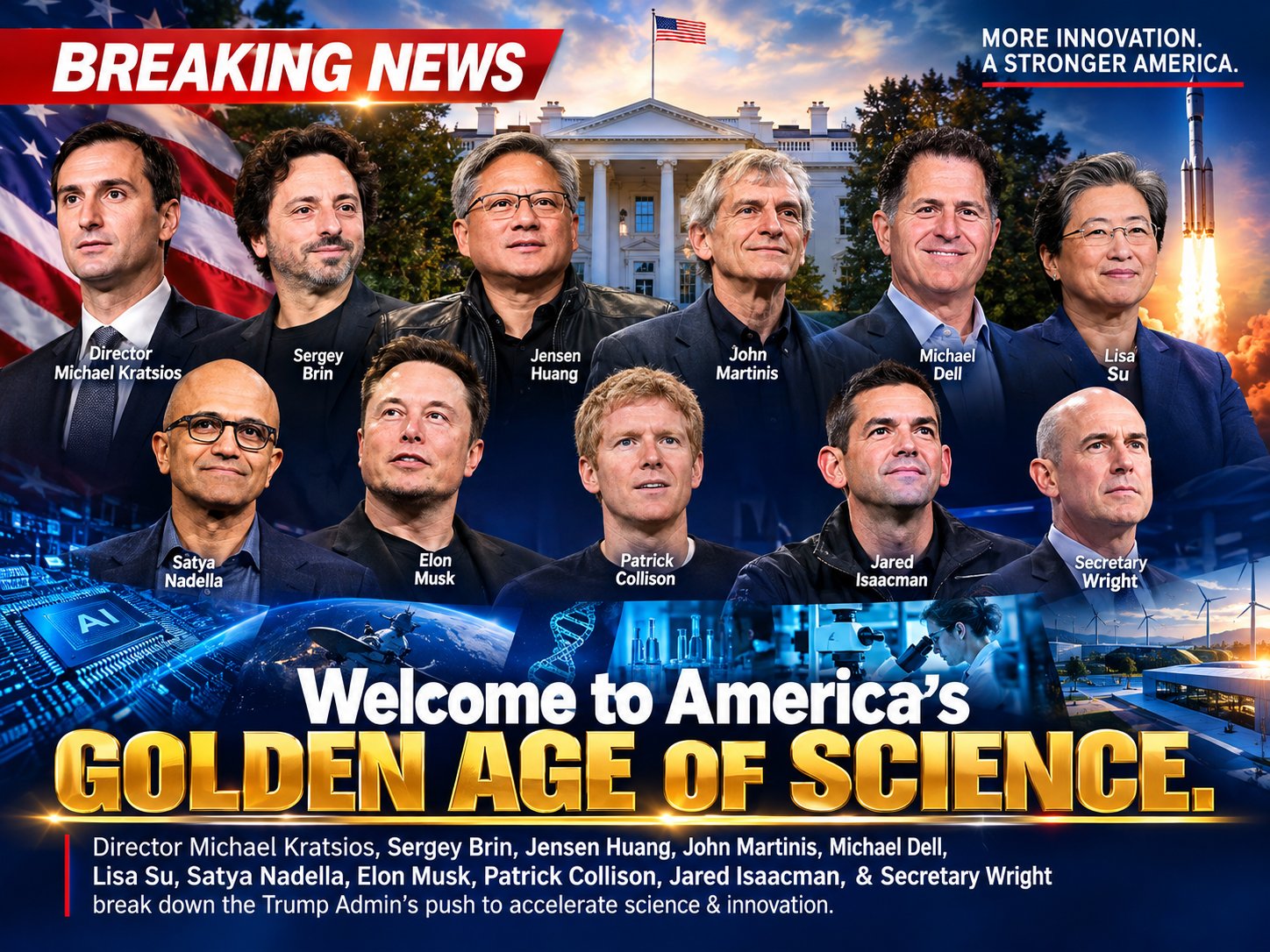
America’s ‘Golden Age of Science’: Trump Administration Rallies Tech Leaders Around Innovation Push
The Trump administration convened an unusually star-studded gathering of technology executives and scientists to promote what it is calling a new golden age of American science, bringing together some of the most recognizable names in Silicon Valley alongside senior government officials to signal a broad alignment between White House priorities and the private sector’s frontier ambitions.
The event featured Michael Kratsios, who leads the administration’s science and technology policy efforts, joined by figures including Nvidia chief executive Jensen Huang, Microsoft’s Satya Nadella, AMD’s Lisa Su, Google co-founder Sergey Brin, and Dell Technologies founder Michael Dell. Stripe co-founder Patrick Collison, entrepreneur and astronaut Jared Isaacman, physicist John Martinis, and Elon Musk were also among the participants. Secretary Wright represented the administration alongside Kratsios.
The gathering underscored the administration’s effort to cast its science agenda in sweeping, optimistic terms — framing the United States as standing at the threshold of a breakthrough era driven by artificial intelligence, quantum computing, and next-generation manufacturing. Officials and executives alike spoke to the need for accelerating research timelines and reducing the regulatory friction that, in their telling, slows the translation of scientific discovery into real-world technology.
The breadth of attendees reflected the range of industries the administration is courting. Huang’s Nvidia has become central to the global AI infrastructure boom, supplying the chips that power large-scale machine-learning systems. Su’s AMD is a direct competitor in that space. Nadella’s Microsoft has made sweeping bets on AI through its partnership with OpenAI. Brin, who stepped back from day-to-day roles at Alphabet years ago, has more recently re-engaged with technology development, particularly in AI research.
Martinis, a physicist who has done foundational work in quantum computing, brought a dimension to the event that extended beyond commercial AI — a signal that the administration’s stated ambitions include basic and applied science at the hardware level, not just software platforms.
Isaacman, who has been discussed in connection with leadership roles in the commercial space sector, added a space-exploration dimension to a conversation that might otherwise have centered on semiconductors and software.
For the administration, the event serves a dual purpose: projecting confidence in America’s technological competitiveness — particularly against China — and building goodwill with an industry that wields enormous economic and political influence. The United States and China have been engaged in an intensifying competition over leadership in AI, semiconductors, and quantum technologies, with both governments pouring resources into initiatives they consider strategically essential.
Critics of such high-profile gatherings often note the distance between aspirational rhetoric and measurable policy outcomes. How federal research budgets, regulatory frameworks, and agency priorities ultimately reflect the ‘golden age’ framing will be closely watched by the scientific community and industry observers in the months ahead.