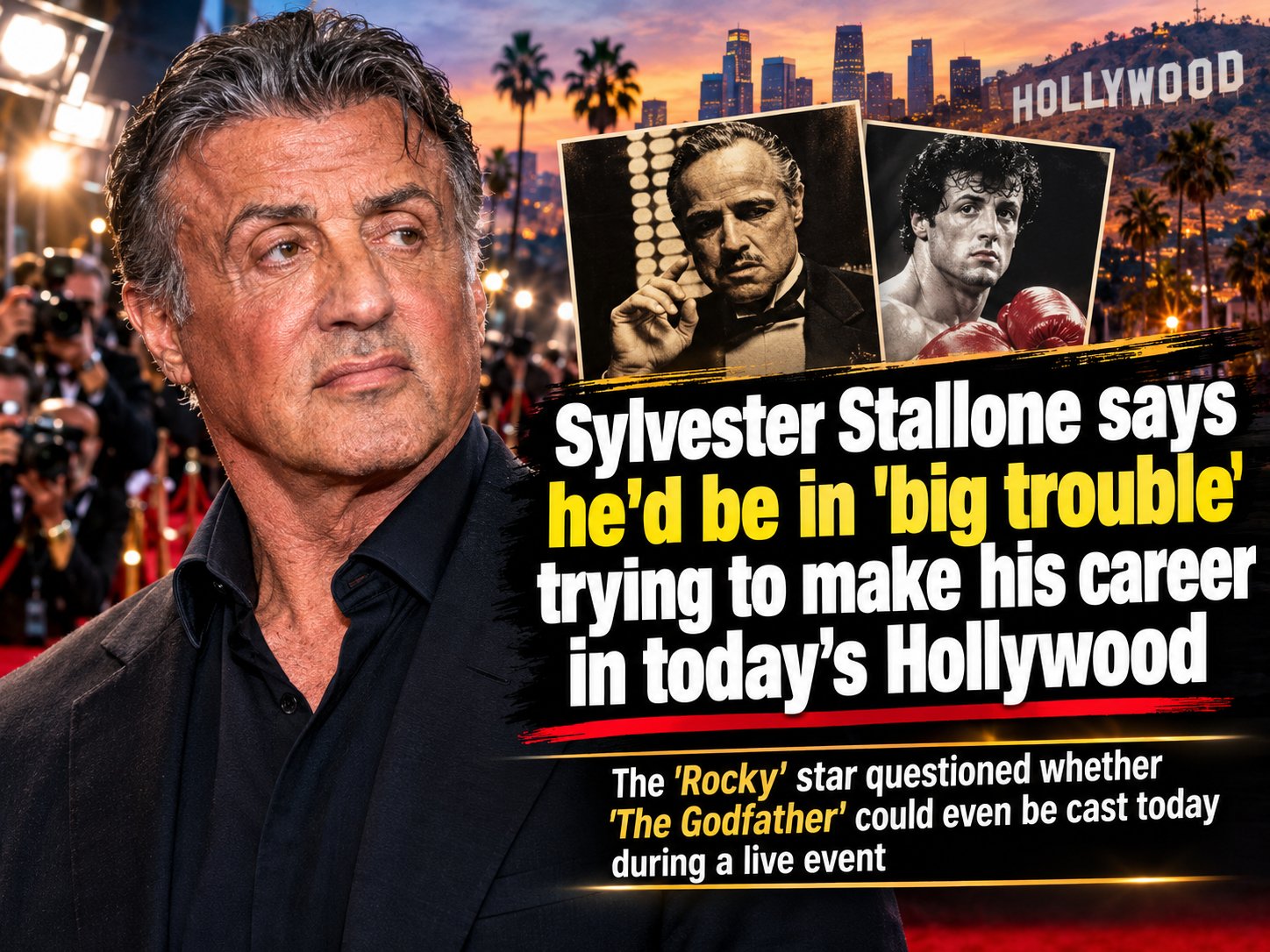
Sylvester Stallone Says He’d Struggle to Break Into Today’s Hollywood
Sylvester Stallone, the actor and filmmaker who built one of cinema’s most enduring careers from the ground up, says the industry he rose through no longer resembles the one that exists today — and he is not sure he would have made it in the current climate.
Speaking at a live public event, Stallone told the audience that he would be in “big trouble” trying to launch his career in today’s Hollywood. He went further, questioning whether a landmark film like The Godfather could even be properly cast under the pressures and priorities that now shape the industry.
The remarks carry particular weight coming from Stallone, whose own origin story is the stuff of Hollywood legend. In the mid-1970s, he wrote the screenplay for Rocky while financially struggling and then refused to sell it to studios unless they agreed to let him play the lead role. The film went on to become a massive commercial and critical success, winning the Academy Award for Best Picture and launching one of the longest-running franchises in cinema history. That kind of all-or-nothing gamble by an unknown writer-actor would face steep odds in an era when major studios increasingly prefer established names, proven intellectual property, and franchise sequels over original stories built around new faces.
His invocation of The Godfather adds another layer to the argument. Francis Ford Coppola’s 1972 masterpiece was itself born out of fierce studio resistance — executives repeatedly pushed back against the director’s casting choices before the film was made. That Stallone would cite it as a potential casualty of today’s Hollywood suggests he believes the forces now shaping casting decisions, whether commercial, institutional, or cultural, have made bold, character-driven filmmaking significantly harder to pursue.
Stallone’s comments arrive amid a wider and often contentious conversation about how Hollywood has changed. The industry has faced simultaneous pressure to broaden representation on screen and behind the camera, while also consolidating around blockbuster franchises and streaming volume strategies that leave less room for the kind of mid-budget, original dramas that defined the 1970s era he came of age in. Critics of that era’s Hollywood are quick to note it had exclusions of its own; defenders argue it produced an unmatched concentration of serious, risk-taking cinema.
Veteran filmmakers and actors have grown increasingly vocal about what they see as a creative narrowing of the industry. Stallone’s remarks fit a pattern of major figures from his generation publicly wrestling with how much the business has shifted — and whether the conditions that allowed their careers to flourish could exist today.
Stallone, now in his late seventies, has remained active in entertainment in recent years, including work on the television series Tulsa King and continued involvement in the Rocky franchise legacy. His comments suggest that even from a position of established success, he views the modern film industry with a degree of skepticism about what it can still produce — and who it might be leaving out.