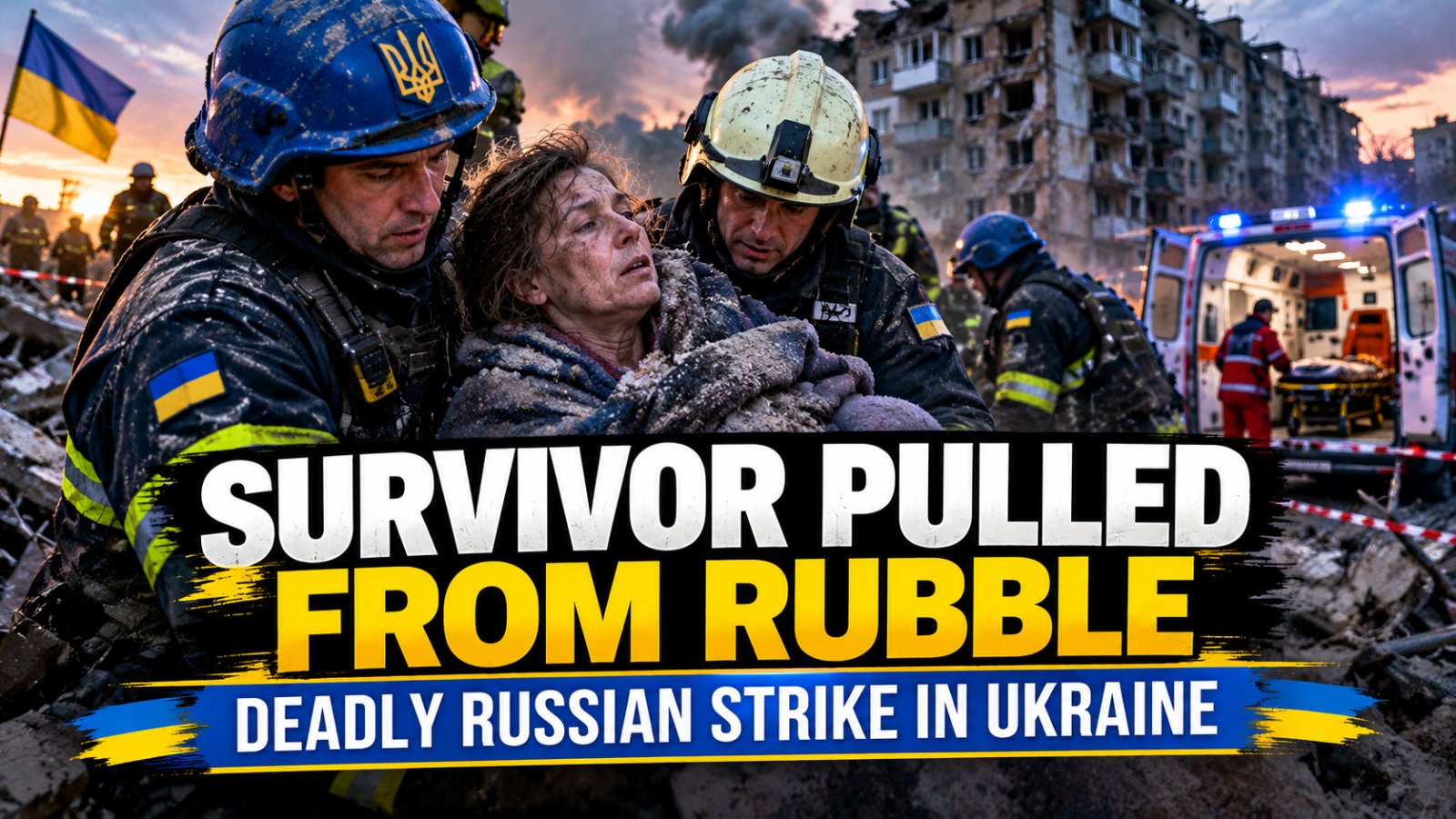
A Moment of Hope in the Rubble: Rescuers Find Survivor After Deadly Russian Strike
Amid the dust and broken concrete that had once been a residential building, emergency workers in Ukraine paused when they heard something — a sound, faint but unmistakable, coming from deep within the debris. Hours after a Russian strike had reduced part of the structure to rubble and claimed lives in the surrounding area, rescuers had found someone still alive.
The scene played out against a backdrop that has become painfully familiar across Ukraine: sirens, orange-vested emergency crews moving carefully through wreckage, and the silence of a neighborhood interrupted by war. The attack, carried out amid a broader campaign of Russian aerial strikes on Ukrainian territory, killed and wounded civilians and caused significant structural damage to nearby buildings.
Ukraine’s emergency services responded quickly, with search-and-rescue teams combing through collapsed floors and shattered walls in the hours following the strike. The work is physically grueling and emotionally demanding — responders must move carefully to avoid triggering further collapses while racing against time for those who may still be breathing underneath.
When rescuers reached the survivor and pulled them free, the moment stood in stark contrast to the grief surrounding it. Footage and accounts from such rescues, shared widely on social media and by Ukrainian officials, often show exhausted but visibly moved emergency workers — a brief, wordless acknowledgment that the effort was worth it.
Russian strikes on Ukrainian cities have killed thousands of civilians since the full-scale invasion began, targeting not only military infrastructure but apartment buildings, markets, and hospitals. Ukrainian authorities and international observers have repeatedly condemned the attacks as violations of international humanitarian law. Each new strike renews calls from Kyiv and its allies for expanded air defense capabilities to intercept incoming missiles and drones before they reach populated areas.
For residents of the affected community, the destruction is both immediate and cumulative. Many have already lost homes, relatives, or neighbors to previous attacks. Yet the same communities repeatedly demonstrate an ability to absorb the shock and continue — boarding up windows, clearing debris, checking on elderly neighbors, and returning, sometimes within hours, to something resembling ordinary life.
The single rescue will not undo the morning’s losses. But for the emergency teams who worked to make it happen, and for a country that has endured years of bombardment, moments like these carry a weight far beyond their size — proof, in the most literal sense, that life persists.